
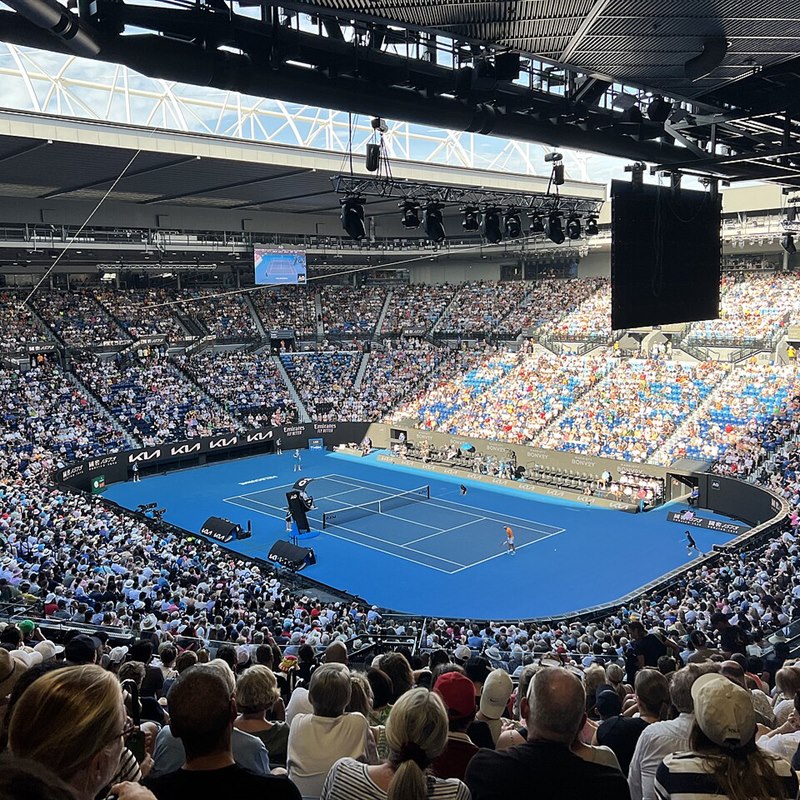
On the first Thursday of the 2026 Australian Open, 103,956 people walked through the gates at Melbourne Park in a single day. The MCG sits about ten minutes away on foot and holds roughly 100,000. So a tennis tournament out drew the largest stadium in the country, on a weekday, and almost nobody in Melbourne thought that was worth remarking on. That reaction, more than the number itself, tells you how the city feels about this sport.
The more interesting question is what happens in the other fifty weeks of the year, when the corporate marquees come down and the sport belongs to people playing section four pennant on a Saturday afternoon. That is the part worth writing about, because it is the part you can actually join.
The fortnight that sets the tone
The 2026 Australian Open drew 1,368,043 people across its three weeks, up 12.4 per cent on the 1.21 million who came in 2025, which was itself a record. It generated an estimated $722.3 million in expenditure for the state, about 27 per cent more than the year before. Melbourne now hosts the best attended Grand Slam on the planet, and it got there by steadily expanding event days, opening hours and public access rather than by building a bigger stadium.
That last point matters more than the attendance figure. A ground pass in the first week buys you a whole day of wandering between outside courts where you can stand three metres from a top hundred player working through a second set. Qualifying week is quieter again and cheaper still. Plenty of Melbourne kids have their first close encounter with professional tennis on court six with a hot chip in one hand, and that informality is the seed of everything else in this article.

Where everyone else plays
Melbourne has more than a hundred locations with free public tennis courts. No booking system, no membership, no fee. You turn up, and if someone is on it you wait or you go to the next one. Councils across the city have quietly kept these going for decades, and they are the reason tennis here has a genuinely wide base rather than being a sport you buy your way into.
If you want a guaranteed court at a guaranteed time, council run venues take bookings for modest money. East Melbourne has eight hard courts running roughly $20 to $30 an hour. Footscray Park has six at about $18 to $22. Brunswick sits around $20 to $28. Parkville runs social tennis on Sunday afternoons for five dollars, and the last Sunday of the month is free. Split a court booking two ways and an hour of tennis costs less than two coffees, which is worth remembering the next time somebody calls it an expensive sport.
Saturday pennant is the real culture
Ask most Melburnians what tennis culture means and they will say the Australian Open. Ask anyone who plays and they will say pennant. Tennis Victoria runs a competition of more than 400 teams drawn from about 140 clubs, with over 3,500 players spread across sections that range from genuinely serious to affectionately shambolic.
The format is home and away, you play sets rather than matches, and you will spend as much of the afternoon sitting down as playing. There is a tea roster. Someone brings a slice. Somebody’s father has played in the same section since 2003 and has opinions about the net height. This is the actual spine of the sport in this city, and joining a club is the single highest leverage decision an adult player can make, because it solves your court access, your competition and your social calendar in one go.

The pathway, described honestly
Australian tennis has a formal development pathway, and it is worth understanding whether or not you have a child who might climb it. Kids start in Hot Shots, which modifies the ball, the racquet and the court size by age so that a seven year old can actually rally instead of chasing lobs into a fence. From there they move into Hot Shots Match Play and the leagues, which are usually a child’s first taste of team tennis.
Next comes junior pennant on Sundays, then regional Junior Development Series tournaments designed to build match confidence without throwing a beginner in against a state squad player. As results accumulate, a player picks up a Universal Tennis Rating, a global scale from 1.00 to 16.50 calculated from actual match outcomes rather than from wins and losses in isolation. UTR is what makes it possible to find a genuinely even contest, which is the whole game at that age. Beyond that sit the Australian Money Tournaments, semi professional events offering prize money and Australian ranking points, and past those the Australian Pro Tour and the international circuit.
Here is the part the brochures skip. The pathway is drawn as a ladder but behaves like a filter, and almost everyone steps off it somewhere. That is not a failure, it is arithmetic. The players who stay in the sport for life are usually the ones who found a club, a Saturday team and two or three people they enjoy hitting with, and the ranking was never the point. If you are a parent, the most useful thing the pathway gives your kid is a decade of structured play. Treat the rest as a bonus.
The problem nobody plans for is who you hit with

You can own a good racquet, live fifteen minutes from a free court and have every Tuesday evening open, and still not play tennis for eight months. The reason is almost never equipment or access. It is that your regular hitting partner moved to Brisbane, or had a baby, or did an achilles playing indoor soccer, and finding a replacement at your level turns out to be weirdly hard for an adult.
Melbourne makes this sharper than most cities. It takes in more new residents than anywhere else in the country, which means a very large share of the people holding a racquet here are rebuilding their tennis network from nothing, in a city where they know six people and none of them play.
This is the specific gap Hitting Partner was built to close. You set your level using UTR, DUPR, NTRP or an honest self assessment if you have never been rated, then browse players, open games and coaching clinics near you. Invitations specify the court, the time and the level, and once someone accepts, the hit lands in both calendars with reminders attached. Push notifications flag nearby games that match what you are after, and a tier system built on genuine reviews gives you some sense of who actually turns up when they say they will. Melbourne is one of its covered cities, alongside Sydney, Brisbane, Perth, Adelaide, the Gold Coast, Canberra, Newcastle, Wollongong and Hobart.
Browsing is free. Player Plus, which adds messaging and clinic RSVPs, runs A$6.99 a month or A$59.99 a year, and new accounts are currently getting six months free. Coaches pay A$24.99 a month or A$249.99 a year for Coach Pro to list themselves, host clinics and take lesson requests, and the app’s pitch there is that it takes no commission on lessons at all, against the 15 to 30 per cent that comparable platforms clip. Framed the way they frame it, a coach on a commission platform teaches 12 to 18 minutes of every hour for nothing. You can find it on the App Store or Google Play.
A word on etiquette, because the app cannot enforce this bit. State your real level rather than your best level. Turn up when you said you would. Bring balls occasionally instead of always being the person who forgot. Do those three things and you will have a full hitting roster inside a month.
Buying gear without wasting your money
There are many ways to buy a racquet badly. Buying the frame your favourite player endorses is one, because those are usually stiff, heavy and built for a swing you do not have. Buying purely on price is another, and so is buying online from a grey importer who cannot tell you what grip size you need and will not be there when the frame arrives strung at a tension that makes your elbow ache.
The better approach is to hit with a few frames before you commit, which is exactly what Sturdy Racquets is set up for. They are a racquet sports specialist based at D/535 Geelong Road in Brooklyn, out in Melbourne’s west, so there is a real shop and real people behind the website rather than a warehouse in another state. They stock Wilson, Babolat, Tecnifibre, Diadem and Dunlop across racquets, balls, shoes, bags and accessories, and they carry pickleball and cricket gear as well.
Three things make them worth the trip. The first is the demo program, which lets you actually play with a racquet before deciding, starting at $9.95. Nobody should spend four hundred dollars on a frame they have only held in a shop. The second is that they string racquets, which matters more than most players realise, because the string you choose and the tension you choose it at change how a frame plays far more than anything printed on the paint job. The third is a side by side comparison tool on the site, genuinely useful once you have narrowed things to three or four options and want to see head size, weight and balance next to each other instead of in separate browser tabs. Shipping is free across Australia and New Zealand on orders over $49.95, and if you would rather just talk to someone, they answer on 1800STURDY or (03) 9314 9365. Their own line about it is that exceptional customer service is part of the value you pay for rather than an add on, and in a category this full of confident nonsense, a shop that will talk you out of the wrong racquet earns its margin.
That middle point deserves more attention than it usually gets. A $150 frame strung correctly plays better than a $400 one strung wrong, and almost nobody works this out on their own. Ring them about grip size, string type and tension for the way you actually play rather than guessing from a dropdown menu, then get into the habit of taking the racquet back in instead of letting the strings go dead in the boot of the car.
Surfaces, strings and surviving a Melbourne summer
You will meet three surfaces here. The blue hard courts at Melbourne Park are the ones on television, fast and unforgiving on the knees. En tout cas, the crushed brick surface that turns half the clubs in this state a dusty orange, is slower, kinder to ageing joints and will ruin a pair of white shoes in an afternoon. Synthetic grass sits somewhere between the two and is what most council courts are laid with. Each rewards a slightly different game, and shoes designed for one will slide unhelpfully on another.
On strings, the rule of thumb that has survived decades of argument is to restring as many times per year as you play per week. Twice a week means twice a year, at minimum. Strings also lose tension sitting in a cupboard, so a racquet you have not restrung since 2019 is not saving you money, it is quietly costing you control. This is the cheapest improvement available to almost every club player, and since Sturdy Racquets do the stringing themselves, it is one errand rather than a project.
Then there is January. Melbourne can push past 35 degrees and the courts hold that heat long after the air has cooled, which is why experienced players here treat the middle of a summer day as unplayable and book early mornings or after seven in the evening. Clubs run heat policies for a reason. Ignoring them is how people end up on a drip instead of in the clubroom.
And yes, pickleball is part of this now
Tennis people made jokes about pickleball for about three years and then quietly started playing it. It is easier on the body, faster to learn, intensely social, and it has pulled a lot of lapsed tennis players back onto a court. Melbourne clubs have been overlaying pickleball lines on existing courts, which occasionally causes friction over booking sheets, though most places have worked it out.
Both businesses above have followed the players. Hitting Partner matches pickleball as well as tennis and uses DUPR ratings alongside UTR, and Sturdy Racquets stocks paddles and balls next to the racquets. If your knees have opinions about singles these days, this is a reasonable place to land.
Start this week rather than next January
Every January, Melbourne watches the best players alive for a fortnight and a decent number of people think about digging the racquet out of the hall cupboard. Most never do, and it is almost never because of money or courts, both of which this city has made about as easy as they can be. It is because arranging the first hit takes ten minutes of effort and nobody has ten minutes.
So collapse it into one evening. Find your nearest free court, get your racquet restrung or demo a new one, and line up someone at roughly your level for Thursday. The rest of it, the club, the Saturday team, the ridiculous arguments about line calls, follows on its own once you are actually playing. Next January will feel completely different when you are watching people do properly what you did badly on Tuesday night.
Featured image: Rod Laver Arena by Gracchus250, CC BY-SA 4.0.
 ozworld.au


Leave a comment