
Ask an Australian six year old what number you ring in an emergency and a genuinely alarming number of them will say nine one one. Not because anyone taught them that, but because roughly every cartoon, kids’ show and streaming series they have ever watched was made somewhere else. The number they have absorbed does not work here, and they have absorbed it thoroughly.
Emergency operators in this country take about 32,000 calls a day, roughly 11.7 million a year. Some of the best of those calls come from small children who knew three things by heart. Getting your kids into that group takes about twenty minutes, spread over a few goes, and it is worth doing before you need it rather than after.
Teach it as “zero zero zero”, never “triple zero”
This is the single most useful thing on this page and almost nobody knows it. Emergency services educators specifically recommend teaching young children to say the number as “zero zero zero” rather than “triple zero”, because a four or five year old often has no idea what “triple” means. A child who has learned the phrase but not the digits can stand in front of a keypad and freeze, hunting for a button marked triple.
So say the digits. Three zeros. Show them where the zero is on a keypad and let them press it three times themselves, because the muscle memory of finding the button matters more than the phrase.
It works from a landline, a mobile, a locked mobile, and a mobile with no credit. It is free from everywhere.
What happens in the first ten seconds
Children handle things far better when they have been told what to expect, so walk them through the actual sequence.
The first voice is not a police officer or a paramedic. It is a Telstra emergency call operator, whose job is to work out which service you need and roughly where you are, then connect you. They will ask “police, fire or ambulance?” That question catches adults off guard, let alone kids, so practise the answer. The operator stays on the line while the transfer happens rather than dumping you into a queue, so the child is never talking to nobody.
Then the rule that matters more than any other. Do not hang up. Children hang up because they are frightened, or because they think they have done it wrong, or because an adult in the room tells them to. Teach them that once the call connects they stay on the phone until the person on the other end says they can go, even if the call goes quiet, even if they are embarrassed. A dropped call means somebody has to ring back and find them, and that costs minutes.
The three things they need to know by heart
Their full name, their home address, and a phone number. That is the whole list, and the address is the one that takes work.
Small kids often know their street but not their number, or know the number but not the suburb, and a street name on its own can appear in forty suburbs across a single city. It helps to explain why houses have numbers at all, using the logic they already understand: every kid in their class has a different name so the teacher knows who is who, and every house has a different number so the ambulance knows which door. Then drill it the way you would a song, in the car, at bath time, until it comes out without thinking. If you live in a unit, the flat number is part of it, and so is the building name if it has one.
Have the conversation about what an emergency actually is, too, because the line is not obvious to a seven year old. Sit down and make a list together of things that are (a fire, someone who will not wake up, someone who cannot breathe, a stranger trying to get in) and things that are not (a scraped knee, a lost cat, a sibling being annoying). Then go through the list and get them to say which of police, fire or ambulance they would ask for. That exercise does more than any lecture.

112 works. 911 does not. And you cannot text for help
There is a lot of confident nonsense online about these, so here is the plain version.
112 is the international standard emergency number and it does work from an Australian mobile. Dial it and you reach the same Triple Zero service. It is not a secret backdoor and it is not more powerful than 000, it simply also works, which is handy for anyone raised overseas who has that number burned in.
911 does not connect you to anything in Australia. If your child has learned it from television, they need to unlearn it deliberately, because in a panic people reach for what they have heard most often rather than what they have been told once.
106 exists for people who are deaf or have a hearing or speech impairment. It is a text based relay service, and importantly it works through a teletypewriter rather than an ordinary phone. It is not a number you can SMS from a handset.
Which leads to the thing teenagers in particular get wrong: you cannot text 000. A generation raised to avoid phone calls will instinctively try to message, and there is nothing on the other end to receive it. If your kids are old enough to have their own phone, say this out loud to them once.
The coverage question, answered honestly
An emergency call from a mobile will use any Australian network it can find, not only the one you pay for. So if your carrier has no signal where you are standing but another one does, the call still goes through. That is a genuinely useful piece of engineering and worth knowing.
What it does not mean is that emergency calls work everywhere. If there is no coverage from any carrier at all, which describes a great deal of this country, then no number works, not 000, not 112, not the one your cousin swears by. Plan around that before you drive somewhere remote rather than discovering it at the time.
Put Emergency Plus on every phone in the house
Knowing your address solves the problem at home. The harder situation is the one at the beach, on a walking track, or at the far end of a park with no street sign in sight, and that is where a nine year old goes quiet because the honest answer to “where are you?” is “I don’t know”.
Emergency Plus is the free app built by Australia’s emergency services for exactly this. It reads the phone’s GPS and displays your location in several formats, including what3words, which carves the world into three metre squares and gives each one a three word name. Reading three ordinary words down the phone is dramatically easier than reading coordinates, particularly for a child, and the words resolve even without data coverage. The app also lists the SES and Police Assistance numbers alongside 000, so it nudges people toward the right number rather than defaulting to the emergency one.
Install it tonight and open it once with your kids so the icon is familiar. An app nobody has opened before is not much use in the ten seconds when it matters.
The numbers that are not 000
Half of teaching kids about emergencies is teaching them what is not one. Print this and stick it on the fridge where they can reach it.
| Situation | Number |
|---|---|
| Life threatening or urgent. Fire, serious injury, crime in progress | 000 |
| Police, but nobody is in danger. Theft, damage, something reported after the fact | 131 444 |
| Swallowed something, wrong medicine, bitten or stung | 13 11 26 (Poisons Information) |
| Storm damage, flooding, a tree through the roof | 132 500 (SES) |
| Sick after hours and unsure whether to worry | 1800 022 222 (healthdirect) |
| A kid or young person who needs to talk, any hour | 1800 55 1800 (Kids Helpline) |
| Anyone in crisis | 13 11 14 (Lifeline) |
One caveat on the health line. Victoria and Queensland run their own after hours nurse services rather than using healthdirect’s helpline, so check which applies in your state and write that number on the fridge card instead.
Rehearse it, on a real phone
Knowledge that has never been rehearsed tends to evaporate under stress, which is the whole reason schools run fire drills instead of just handing out a pamphlet. Dig out an old handset with no SIM in it, or a disconnected landline, and let your child actually dial and speak. You play the operator. Ask the real questions, in the real order, including the awkward ones. Then swap and make them the operator, because explaining something is how you find out whether a kid has understood it.
The government runs a free resource for this called the Triple Zero Kids’ Challenge, an interactive set of games and scenarios built with emergency services for exactly this age group. It is genuinely well made, and it means the message arrives from somewhere other than a parent, which for some children is the difference between listening and nodding.
Cover prank calls in the same conversation, without turning it into a threat. The useful framing is not that they will get in trouble. It is that there are a limited number of operators, and a call made for fun occupies one of them while somebody else is trying to get through. Kids understand queue jumping. Put it in those terms and most of them get it immediately.
Twenty minutes, once
None of this requires a family meeting or a laminated plan. It is a keypad, an old phone, an address said out loud until it is boring, and one conversation about what counts as an emergency. Do it on a Sunday afternoon with no particular occasion attached, which is also the best way to keep it from being frightening.
The kids who make good calls are almost never the ones who happened to stay calm. They are the ones who had done it before, in a lounge room, on a phone that was not connected to anything, while somebody pretended to be the operator and asked them where they lived.
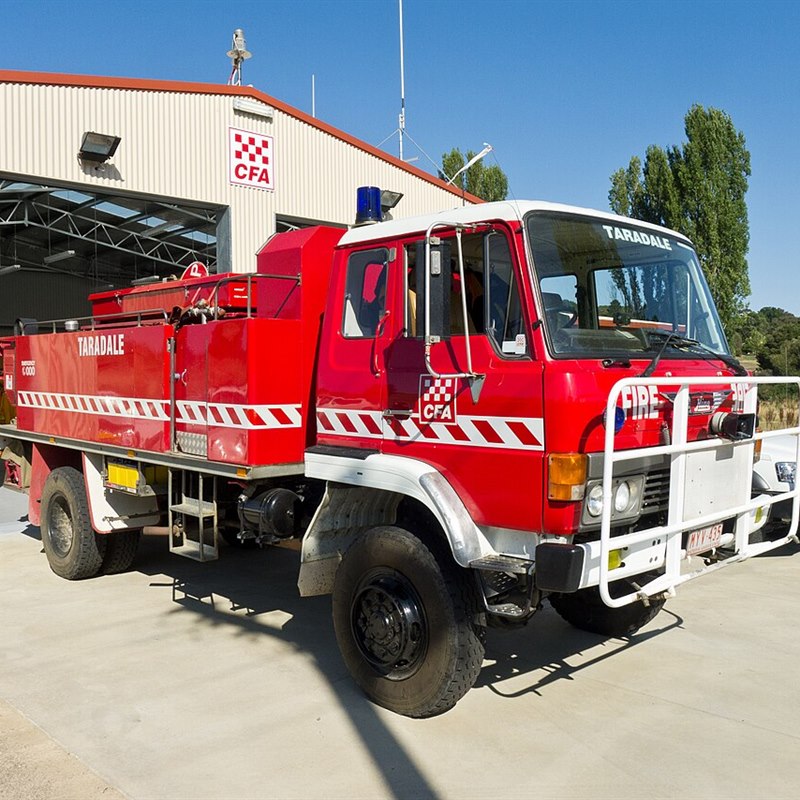
Featured image: Taradale CFA tanker by Davidonformosa, CC BY-SA 3.0.
 ozworld.au


Leave a comment